
A Localization Case Study in Brazilian Portuguese and LATAM Spanish
As every fan knows, SpongeBob humor moves fast and hits hard. It’s also surprisingly precise: when the timing is perfect, a single word will often carry the joke. Localizing that kind of humor, of course, requires the same precision. Miss that crucial beat in the target language, and the joke can fall flat, or worse, result in audience confusion.
When Purple Lamp and THQ Nordic commissioned Terra to localize both the text and full audio for SpongeBob SquarePants: Titans of the Tide into Brazilian Portuguese and Latin American Spanish, our team understood the stakes. Any localized rewrites had to sound true to SpongeBob, and all audio performances had to align with each region’s established dub. All the while, these versions had to maintain a smooth and intuitive feel during gameplay, from localized tutorials to in-the-moment action.

Dieggo Lessa Arnoldo, translator and proofreader for Brazilian Portuguese, described the team’s core priority in terms of character. “When you start working on a series,” he said, “it’s important to maintain the characters’ personalities so that the translation remains faithful to the original material.”
The Creative Target: Keep the Show Inside the Game
Comedy in Titans of the Tide leans into two recurring SpongeBob patterns. One is theme-driven humor: in this case a ghostly takeover of Bikini Bottom serves as the central running gag. The other is the classic SpongeBob undersea twist in which everyday words are given an oceanic makeover, like “seaquake” taking the place of “earthquake.”
To keep these patterns consistent in the target languages, Terra’s linguists treated existing canon as an immovable constraint that informed their entire approach, to everything from broad thematic elements to finer details like cosmetic items, which often reference specific episodes or well-known memes. Research and franchise literacy were part of the workflow from day one.
Side-by-Side Jokes, Rebuilt with Intent
At first glance, the funniest SpongeBob lines often seem like they’d make for a simple translation. But making that humor and timing work in another language while accommodating the timing and space constraints of a video game, itself, can be a fascinating challenge). Titans of the Tide gave us plenty of opportunities to tackle jokes that hinged on a single sound or a split-second pause, often while leaning into the familiar and famous SpongeBob brand of nonsense. The solutions we arrived at in Brazilian Portuguese and LATAM Spanish rarely followed the same route, but localization experts on both teams were still aiming for the same outcome: lines that land fast and feel native.
When the Wait Passes as Weight
One example of a punchy joke that required diverse paths to success is a line that, in English, is a play on a “wait” versus “weight” homophone. In English, the joke works because the word you expect and the word you hear share the same sound. Brazilian Portuguese could not mirror that exact trick, so the team rebuilt the punchline around what the scene was showing. Their solution, “Eu já ‘voo’! Haha!”, uses the sound overlap between “vou” (“I’m going”) and “voo” (from “voar,” meaning “to fly”) to keep the quick twist, while also tying the gag to the moment’s physical action. In LATAM Spanish, the team found a different way forward. “Espésame” echoes the sound of “espérame” (“wait for me”) while leaning on the meaning of “pésame” (“weigh me”), so the audience still gets the same misfire in a single beat, even though the mechanics behind it are different.
Misunderstanding Between a Ghost and a Goat
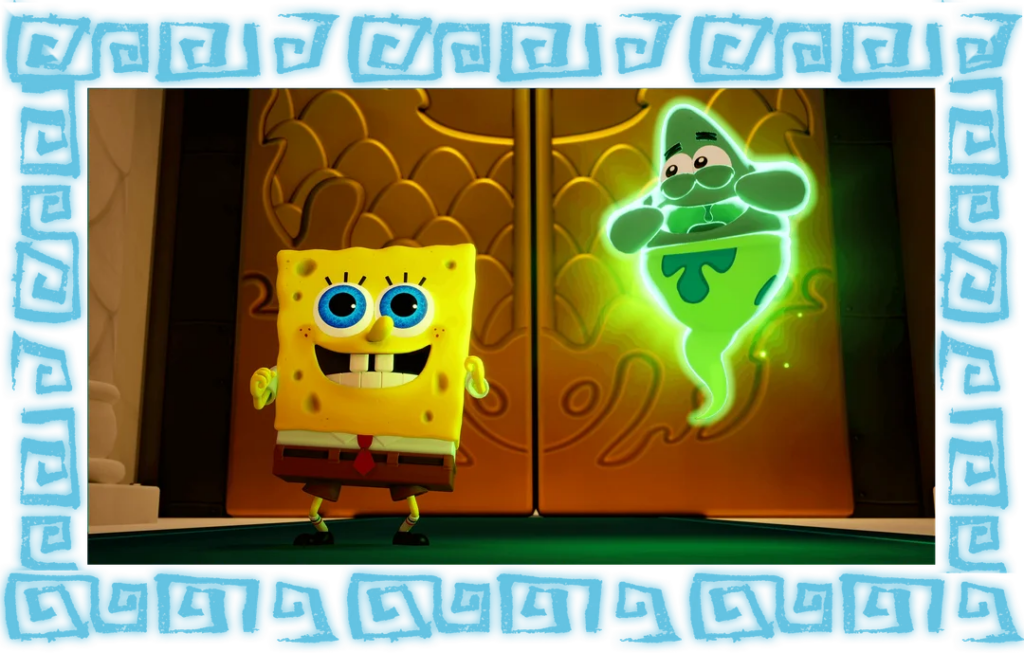
Another case exhibits an example of SpongeBob humor relying on misunderstanding and panic, then relief. The original English line is, “Ghost?! OH! I thought I had turned into a goat! Whew!” The Brazilian Portuguese version of the joke relies on a phrase players recognize instantly, “alma penada,” which refers to a type of ghost from Brazilian folklore, and flips it into “alma pelada” (“naked soul”), creating a near-miss that feels like something SpongeBob would say out loud in a rush. The LATAM Spanish solution could not follow that same word shape, so the team rebuilt the moment around a rhyme-driven structure that translates “goat” as “plasma” to create a phonetic match with “fantasma” (“ghost”). The LATAM solution maintains the same rhythm of fear and confusion before the reset, which is what makes the line funny during gameplay.
Mr. Krabs’s Distinctive Voice

Mr. Krabs is a character who offers excellent proof that sometimes, the way a character sounds is just as important as what they say. Mr. Krabs uses a loud, hoarse, “pirate” voice with a Scottish brogue, and often over-pronounces his “R”s. His speech is characterized by spelling and grammar mistakes, such as using “me” for “my” (e.g., “me money”) or “ye” for “you.” Alejandro Kochol, the language specialist who worked on LATAM Spanish for Titans of the Tide, noted that the team kept Krabs rough and eccentric by leaning into nautical language and playful, “wrong” forms of speech. They even went so far as to introduce a made-up word in the phrase, “¡Una hamburguesa al día espanta a la fantasmería!” (“A patty a day keeps the ghosts away!”), where “fantasmería” does not officially exist in Spanish language. The choice to go with a fabricated term matters because it prioritizes character over correctness. In the end, it gives Krabs a voice that feels consistent with the franchise dub, maintains the comedic feel, and avoids turning Mr. Krabs into a different character in Spanish.
Building the Fantasy Inside the Booth
During Brazilian Portuguese recording, a line involving “jellyfish” sparked a quick but notable adjustment. Instead of “pescar águas vivas” (fishing for jellyfish), actor Wendel Bezerra, who has been voicing SpongeBob for nearly three decades, suggested “caçar águas vivas” (hunting jellyfish) to align with the way the series frames SpongeBob’s jellyfishing as an enthusiastic pursuit with a net. The idea was a minimal verb swap, but it went a long way to pull the line closer to the established canon. Moreover, it sounds like SpongeBob, which is exactly what players notice when they’ve grown up with a specific version of the show.
These four cases demonstrate the real craft behind humor localization. The Brazilian Portuguese and LATAM Spanish teams did not chase identical solutions, but they achieved the same outcome, by using the tools each language offered, and by relying on their franchise knowledge to keep the humor sharp, fast, and unmistakably SpongeBob.
When Humor Meets Clarity
In a game like Titans of the Tide, humor can’t come at the expense of clarity. That means any comedic element must support gameplay, instead of getting in its way. When humor risks interfering with understanding, particularly in tutorials, it’s suddenly a lot less funny.
Dieggo explained the balancing act in practical terms. “The focus will always be on making the term clear and adapting everything with that in mind,” he said, “even if sometimes the joke has to be left out for the sake of gameplay.”
When it comes to objectives and player-facing clarity, Dieggo also emphasized consistency choices that help players build mental models faster, including verb tense control and the signaling of key terms. “Fortunately, in most cases, the jokes could be adapted without any problems.”
Keeping the Cast and the Identity in Audio Production

For a franchise like SpongeBob, character voices are an essential part of the brand itself. “That’s why maintaining the established voice casts for both Brazilian Portuguese and LATAM Spanish was a priority for THQ Nordic,” explained project manager Thiago Kunis. The audio specialists initially worked with casting lists developed during the creation of previous SpongeBob games, but soon realized that some actors, whose earlier performances had helped endear the franchise to so many, could no longer participate. Terra then stepped in to facilitate the signing of very specific talent to Titans of the Tide: the new actors whose voices were already familiar to fans of the TV show, thanks to their stepping up to take on the roles of their predecessors in recent years.
The goal, of course, was consistency across mediums, and after informing THQ of the updated casting, it was time to get into the booth. But it turned out that the decision to keep the casting aligned with the television show also introduced some logistical complexity. Diverse scheduling and location constraints meant, in the end, that recording sessions involved studios in Brazil, Mexico, and Venezuela, with voice actors, themselves, spread across five countries.
Despite the additional considerations that the casting updates required, the audio team navigated its tasks with a shared sense of purpose and creativity, particularly when it came to staying true to the canon, maintaining performance quality, keeping the voice actors comfortable, and ensuring that pacing was always on the mark.
Technical Constraints in Solving Sync Without Cinematics
Not every project arrives with the same reference package. In the case of Titans of the Tide, Terra’s team did not have cinematics available for adaptation reference.
Still, some lines were flagged as “sound sync” by the developer, which allowed us to match localized timing to the original audio waveforms and deliver files aligned with on-screen mouth movements to match the characters.
That kind of workaround is a good reminder that audio localization depends as much on language and performance as it does on technical savvy and adaptability. When one input is missing, the workflow needs a replacement that still protects immersion.
The Takeaway
Successful humor localization is built on small creative choices, where something as subtle as a vowel swap can save a joke, a made-up word can preserve a character’s voice, and even a single verb can protect the canon in the booth.
For Titans of the Tide, Terra’s Brazilian Portuguese and Latin American Spanish teams aimed for the same result: players should feel like they are hearing their SpongeBob, not a generic version, as they happily sink into his game world. That meant our teams prioritized respecting the franchise’s history while rebuilding wordplay with local tools—all while also supporting audio production with context and sync-friendly adaptation.
When the localization is done right, the jokes land and nothing gets in the way of audience comprehension. Just as importantly, the voices delivering those jokes feel right, too, which is exactly the kind of polish players notice, even if they never see the effort behind it.