
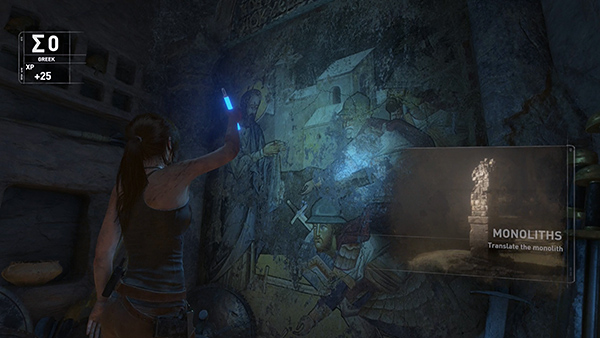
There’s a moment in Rise of the Tomb Raider when Lara walks up to a crumbling monolith. The player expects information, but she hesitates; her Greek isn’t strong enough yet. A few murals later, the bar fills, and she returns to read the message. What once looked like decoration now reveals a clue and a new path forward.
That quiet mechanic feels familiar to anyone who works with languages. Fluency is not something you unlock in one fell swoop; it builds over time through interaction: with other people, with general aural exposure, with reading and writing lines of text, and more. Lara, like all of us, learns through engagement rather than repetition. Her experience reminds us that language acquisition in games is an important part of the story, and one that should be part of the narrative from its design stage.
What could game teams gain by treating language as Lara does, with focus, care, and a sense of purpose? Let’s find out.
Linguistic Growth as Part of Progression

Lara’s proficiency develops through active exploration. She pays attention to the world around her, and as her knowledge grows, so does her access to the game’s deeper layers and secrets.
Professional linguists build that kind of knowledge through every gaming project they engage with. In a project shaped by mythology or invented lore, lingual fluency is only the starting point. Their work also requires them to focus on how the story reveals meaning over time, especially when a clue depends on what the player is supposed to know at that moment. As that context accumulates, linguists can make stronger choices for dialogue and carry the game’s internal logic into another language.
Style guides and shared glossaries make that accumulated knowledge usable beyond one person’s work. These tools give teams a shared reference, so key decisions do not depend solely on an individual’s memory or personal interpretation. Much like Lara’s notebook, these tools preserve what has already been learned and help keep the adventure coherent for everyone who joins the project later.
When Language Moves the Story
Across Lara’s journey, language appears throughout the world in ways that shape not only how the player reads the adventure, but how they experience it, too. Even when linguistic elements sit at the edge of the story’s main path, they still enrich the gaming experience as the player uncovers more.
Linguists can support that sense of progression by treating language with same the attention that Lara pays to every clue: as an essential element that guides discovery, deepens context, and keeps the character moving through the world. It can be helpful for them to bear in mind that:
- Text localization helps players read the world. Like the inscriptions an archaeologist deciphers, journal lines and environmental text need to connect meaning to action in a way that prompts players to follow hints without being pulled out of the narrative.
- LQA tests language in context. Just as Lara’s understanding depends on where and when information appears, localized text must appear at the right moment and work naturally within the interface, so the intended discovery remains clear.
- Audio localization carries the scene’s emotional intent. Like Lara’s reactions to danger or revelation, localized voice and timing need to reflect what the moment asks of the player.
Scenarios like these are a powerful reminder that in games like Tomb Raider, language does more than inform. It moves the entire story—and playing experience— forward.
Linguists as Interpreters of the Journey
In the Tomb Raider universe, Lara deciphers what others left behind. In development, linguists and LQA teams take on a similar role by interpreting the narrative’s intent and helping each clue or description land with the right meaning, in every language.
Their work maintains coherence across regional versions, especially when the game includes invented dialects or layered historical references. A riddle should not lose its aura of mystery because the wording becomes too direct, and a cultural reference should not feel disconnected from the world the player is exploring.
This level of care depends on collaboration between the people shaping the game and the linguists carrying that experience across languages. When that collaboration works, every detail in the game can support the same journey for players in different parts of the world. The experience remains intact, even as the language changes.
The Takeaway
Lara’s relationship with language can serve as a powerful reminder that understanding is built through close attention to the right resources. In game development, that same mindset can elevate the player experience across regions when language is treated as part of the design from the start. Every progressive clue can then guide the player with its full meaning intact, while every narrative detail maintains its place in the broader journey.
That ideal outcome is what skilled linguists and LQA teams help make possible. Their work shapes the path that players follow, by ensuring language supports discovery, rather than serving as a decoration around it.