
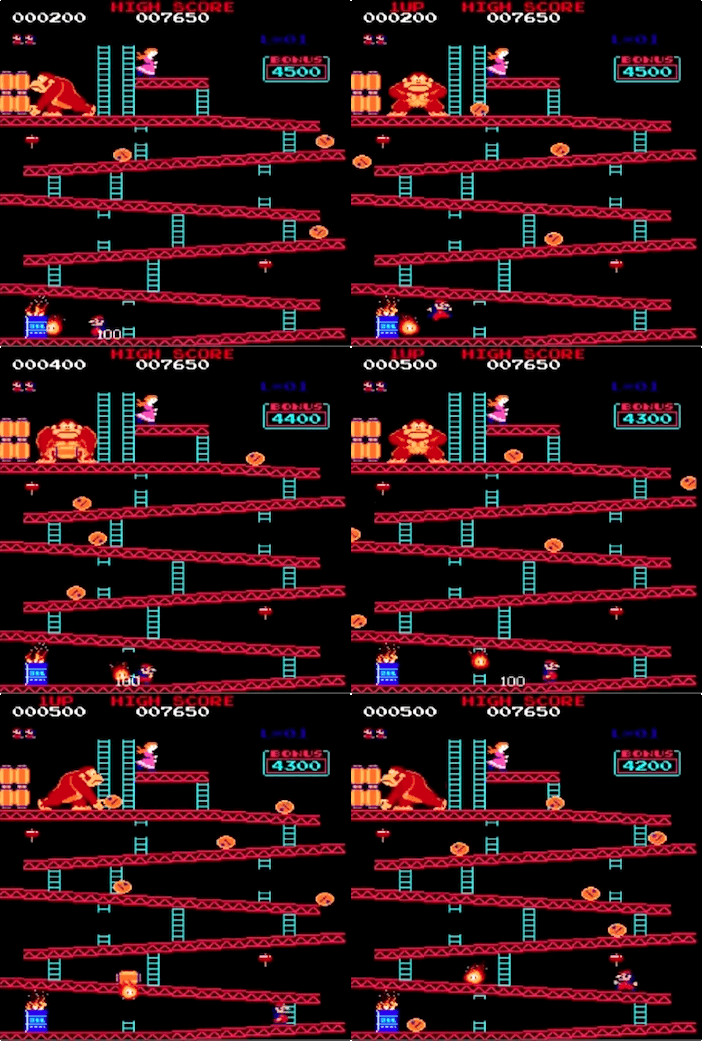
When Shigeru Miyamoto created Jumpman for Donkey Kong, he styled the character as a carpenter. The choice made sense: the game was set on scaffolding and featured barrels and beams everywhere. But when Miyamoto’s next project moved underground into a world of pipes and brick blocks, the context changed. The carpenter’s identity no longer fits, so Jumpman became Mario, a plumber.
The decision to alter Jumpman’s craft wasn’t about aesthetics, but function. A plumber character made the game easier to read and even easier to follow. Pipes weren’t just platforms anymore, but conduits that became a part of Mario’s world and identity.
The kind of thinking that fueled Jumpman’s evolution more than forty years ago continues to guide how we localize games today.
Language Must Meet the Moment

Context encompasses more than what’s displayed on screen. It also encapsulates the pacing of dialogue, the weight of a pause, and the rhythm of a fight. Both text and audio localization teams rely on those signals to make the right choices when adapting a game to a new audience.
These teams know all too well that timing and context shape how players interpret what they hear. A joke can fall flat if it’s delivered during a tense moment, just as a tutorial line may overwhelm players at a point when they’re already under pressure. Even a character’s sarcasm can cause confusion if it’s delivered too seriously. These issues can rarely be pinned down to language issues alone. More frequently, they emerge when audio or text does not align with what the player is experiencing at the moment.
That’s why good localization starts with asking: What’s happening when this line plays? To answer that, teams need more than a spreadsheet. They need to know:
- Who’s speaking, and why
- What the player is doing when the line appears or is delivered
- How the moment feels (tense, exciting, placid, triumphant, etc.)
- What other sounds or actions are overlapping with the dialogue in that moment
- How long the player will hear, read, or act on the line
These layers shape both word choice and delivery. Context tells translators how a line should feel, not just what it should say. And it also tells voice directors when to go for subtle, funny, bold, or restrained deliveries.
Culturalization Starts with Context
Just as Mario’s job changed to fit a new setting, localized content often needs to adjust to fit a new audience. Tone, humor, and references all ride on signals that aren’t always shared across cultures. A character who’s playful in English, for example, could sound childish in another language if the tone isn’t adapted.
Enter culturalization. This process is not meant to rewrite the game, but to ensure players in different regions receive the same emotional cues and narrative clarity. That way, the original story remains intact, while its meaning and tone are clarified for every audience.
These shifts are born from expert linguists’ understanding of both the source material and the target audience, and how best to align the two through context.
Context Is Design
Just as game designers use environment and movement to guide players, localizers use context to guide meaning. What works in a flat file often needs fine-tuning once it’s in the world.
That’s why localization, whether it’s adapting scripts, directing voice sessions, or testing in context, is an active part of game design, and not just a feature of post-production.
When localization is properly contextualized, it fades into the background. Characters feel utterly natural, the game world feels alive, and players stay focused on the experience.
The Takeaway
Miyamoto didn’t make Mario a plumber to be clever; he did it because the world around the man with the mustache and overalls had changed. Mario’s new profession followed that cue. That’s what great localization still does today on multiple levels of game design: it listens to the game, reads the moment, and delivers language that is, contextually, a perfect fit.