
The video game industry loves the momentum that new tools create. When fresh tech arrives on the scene, competitors start experimenting and suddenly, every team feels they’re expected to “do something with AI” not now, not soon, but yesterday. Game localization teams often sit right in the blast zone, partly because translation is one of the most visible use cases for large language models (LLMs), and partly because global releases make time pressure feel like a permanent fixture of the production pipeline, especially in games as a service (GaaS).

Belén Agulló García, chief innovation officer at Terra, is no stranger to this form of tension: “We as humans don’t tend to ask why nearly as often as we should,” she says. “Instead, we focus on the how because we want quick results to show we’re making progress. We like to signal innovation, but when the creative stakes are high, that habit can turn AI adoption into a hunt for shortcuts instead of an actual strategy.”
A better approach, Belén says, begins with a simple shift in mindset: teams should treat AI implementation as a design problem instead of a tool purchase. In some respects, game development already teaches this lesson well. You would not ship a new combat system without testing how it feels first, just as you wouldn’t bolt a quest log onto a story-driven RPG and just hope it fits. Bringing AI tools into the production loop deserves the same level of intent.
Start with the “Why” Before You Touch the Workflow
Most conversations about AI adoption begin with cost and speed. Improving upon both can be valid goals, but they are not a strategy on their own. Belén prefers to define goals by using the Socratic approach of asking questions until the real objective becomes clear. If cost reduction seems to be the obvious ideal, what is driving that need? Is the team trying to protect its localization budget during a rough quarter? Expand into more languages? Perhaps free capacity for content that currently gets ignored, like video, images, and live events?

“The why defines what success looks like for a particular project,” Belén says. “A plan built to reduce spend will end up looking very different from a plan that’s built to improve player experience, or scale accessibility, or shorten time to market without sacrificing tone.” However, the plan is formulated, Belén offers a strong recommendation for its execution. “Make sure you know your business KPIs and protect them,” she says. “If the quality of the player experience starts to suffer, you might start seeing churn, lower retention, or negative player sentiment reviews across the board.”
In game development, risk is not abstract. In fact, it can take many tangible forms, like a slightly “off” tutorial line that confuses the player, or a flat joke that drains a scene’s energy, or even a mistranslation of an item’s effect. Missteps like these menace the balance of in-game mechanics. It’s little wonder that localization decisions, placed in the hands of an AI tool, can have corrosive effects on game design and community trust, especially once players start comparing versions and calling out inconsistencies.
Build the Foundation Before You Scale
Once the purpose for AI adoption is clear to all stakeholders, the next step is preparation. Belén identifies four considerations that can help determine whether AI will help or hurt your goals.
- Data. If you’re planning to fine-tune machine translation or use an LLM enhanced with your own data sources, your translation memories and terminology need to be clean, consistent, and legally cleared. Style choices must be stable, including register and inclusive language rules; otherwise, you introduce confusion into the system’s training.
- Source content. AI cannot rescue unclear writing at scale. If the source text ignores localization best practices, then automation amplifies the mess. Tightening source quality is often a bigger win than swapping engines.
- Content prioritization. Games contain radically different types of text. UI strings, marketing taglines, lore books, store descriptions, live ops announcements, and player support articles do not all present the same risk. Classifying content by visibility, complexity, impact on end users, and creativity levels can help teams select an AI approach that matches the profile.
Language prioritization. Not every language performs equally well under the same AI setup, and performance can change according to content type, too. A strategy that works for one market can misfire in another, so planning requires real evaluation, not assumptions.
Choose Pipelines that Respect Creative Stakes
A strong AI strategy does not force everything into a single pipeline. Belén prefers to lay out a localization value spectrum that prioritizes premium human workflows for high-risk or high-visibility content, and continues through MT post-editing and quality estimation, all the way to fully automated MT for low-risk use cases.
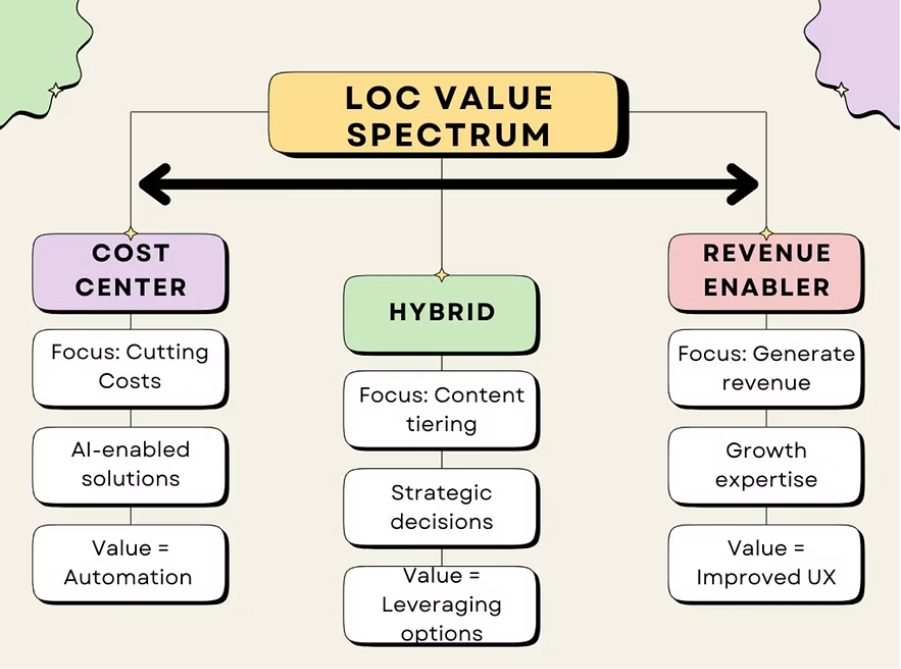
For game production, Belén says, the practical takeaway is simple. “Localization teams are the content experts within their organizations. They’re the people best equipped to create a content-prioritization matrix that links content types with globalization pipelines, which allows them to be more strategic and make the most out of technology and human talent.”
At the same time, she adds, AI applications can extend well beyond translation. “You can still use AI in supportive ways. For example, if you wanted to speed up terminology lookups, or surface style guide answers, or flag sensitive topics for review, or reduce repetitive admin tasks.”
Belén also draws a useful line between automation and augmentation. GenAI is stochastic by default, which makes it a shaky choice for fully automated, deterministic tasks when precision is required. This is especially true if guardrails are not put in place. Augmentation often delivers better outcomes, as it helps experts work faster and more consistently, while keeping ownership of meaning where it belongs: in the purview of human linguists.
One key piece of advice from Belén should be a part of every localization strategy: “You must listen to your language specialists and UX experts,” she says. “If they say the output is not working for a language pair or content type, treating that feedback as optional puts the brand at risk and creates burnout in the people doing the hardest work.”
The Takeaway
AI can be a smart addition to a game localization program, but only when it serves a clear purpose and allows for human creativity to carry the experience. Planning AI tool adoption should start with identifying the why before data and content and content are prepared. Finally, pipelines should be selected that match risk, visibility, and player impact.
When teams treat AI decisions like game-design decisions, they avoid the trap of doing the same work faster while making the player’s experience thinner. Instead, they end up with localization workflows that scale without sacrificing the uniquely human elements of games that players came for in the first place.