
In a world increasingly shaped by automation, it’s tempting to believe AI can do it all: translate text, mimic tone, even capture cultural nuance. But when it comes to video game localization, the cracks in AI’s abilities are obvious.
Behind every epic line of dialogue, every punchy item name, and every atmospheric hint, there are more than words at play. Intent, emotion, and cultural nuance are also in the mix. So what happens when elements like these get lost in translation?
The Tradeoff: Speed vs. Soul
At the 2025 Translating Europe Forum, researcher and professor Ana Guerberof of the University of Groningen shared findings from a study measuring creativity in translation across various workflows. The results? Human translators were, by far, the most creative at adapting content for deep resonance with an audience. Post-edited or AI-generated content, by contrast, consistently scored lower on what the researchers called the Creativity Index. Large Language Models (LLMs) fared better than traditional Machine Translation (MT), but still couldn’t match the nuance and inventiveness of the human mind.
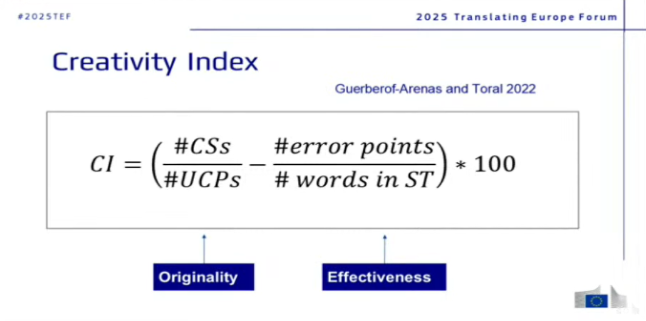
For Belén Agulló García, chief innovation officer at Terra, these results were affirming. “It might be obvious to language service providers that humans are more creative than machines,” she says. “But for those outside our industry, that’s not a given. These results help us explain what’s lost when we let machines take the lead, especially in creative domains like video games.”
Quantifying creativity isn’t easy, but this research finally gives localization teams the data they need to back up what they already see in their day-to-day work: when we remove the human element from the translation process, something essential disappears.
Examples of Where AI Falls Short
Let’s bring the data to life. Below are three examples that show how AI struggles with creativity, tone, and cultural adaptation in game localization.
| Situation | Example |
| Translating an item name that involves wordplay | Weapon name (original – English): Punisher’s Pick Description: “Great for cracking skulls and bad puns.” AI Translation (Spanish): Pico del Castigador Description: “Ideal para romper cráneos y malos juegos de palabras.” Problem: The result is a too-literal translation of “Great for cracking skulls and bad puns.” It’s correct, but it feels stiff. |

Why it fails:
The humor of the original doesn’t carry over as well because the AI’s literal translation flattens the joke. A human translation might keep the pun playful and energized, like “Perfecto para reventar cráneos . . . y chistes malos.” (Perfect for cracking skulls . . . and bad jokes.) Changing “juegos de palabras” for “chistes malos” showcases the power of pithy word selection while delivering a pun.
| Situation | Example |
| Cultural reference in dialogue | Original (English): “Looks like someone skipped stealth class at ninja school.” AI Translation (Japanese): “忍者学校で隠密の授業をサボったようだ。” Problem: The AI translation means, “It looks like he skipped stealth class at ninja school” It’s written in a very neutral way, without offering its Japanese audience the level of context they’re used to. |
Why it fails:

Again, this is an example of AI offering a technically correct translation, but one that still misses the mark. It’s contextually awkward for the target audience, and for these Japanese players, it also fails in terms of cultural tone. Players can’t discern who is talking to whom, and the translation reveals nothing about the relationship between the two characters who are speaking.
A human translator might rework it to: “あんた、忍者の基本を忘れてるね。” Loosely, this translates to “You forgot Ninja 101,” and tonally, it sounds like a middle-aged woman talking to a younger person. This version feels snappier, more idiomatic, and more aligned with expectations and local humor while also accounting for the characters’ context.
| Situation | Example |
| UI prompt with the wrong tone | Original (English): “One more life. Make it count.” AI Translation (French): “Une autre vie. Faites qu’elle compte.“ (Another life. Make it count.) Problem: With only one life left, the player’s situation is dire. But “another life” strikes a softer tone, almost as if it’s a positive silver lining. |
Why it fails:
The AI-generated rendition is too formal and lacks the urgency or energy of the original. A human fix might be: “Une dernière chance. Ne la gâche pas.” (One last chance. Don’t waste it.) We know, right? The stakes feel real again with this new version.
Innovation with Purpose ≠ Inevitable Automation
In the video game world and elsewhere, innovation is often sold as a positive means to acceleration. Looking for faster workflows? Turn to the very latest automation solutions to achieve your goals!
The idea seems to be, the more automation you incorporate, the less friction you’ll experience. But in the rush to scale everything, it’s easy to lose sight of the one thing that makes games unforgettable: creativity.
In game localization, creativity isn’t just a bonus, but the core of a player’s experience. It can be appreciated in how a punchline lands, how a villain sounds truly unhinged, or how a myth feels deeply familiar, as if it were born in your backyard. And while AI tools are undeniably transforming our workflows in some respects, this new research is revealing what many of us in the field have long felt: relying too heavily on automation comes at a cost.

The key, Belén says, is knowing when automation helps the team, and when it hinders the experience. “Content tiering is essential to create an AI strategy that is meaningful and adds value,” she explains. “Understanding your content and the impact that it will have on your end users will help you inform your strategy. AI can work well for support articles where the impact on the players is low, and the language is usually clear and well-structured. But it might be less efficient for highly contextual in-game content or scripts full of puns, humor, and cultural references.”
At Terra, Belén is all about striking a positive balance. “We believe in innovation with purpose,” she says. “Not all automation is bad. But not all automation is worth the creative cost. The challenge is figuring out which is which to get the best out of both worlds.”on is worth the creative cost. The challenge is figuring out which is which to get the best out of both worlds.”
The Takeaway
In 2025, one theme came up repeatedly on stages and in talks across the industry: how do we preserve quality, culture, and creativity in a time when scale and automation dominate? Our answer: keep humans at the core. Not just for quality assurance, but for the kind of experience that makes players laugh, flinch, wonder, or cry. In a world saturated with AI-generated content, the only way to stand out is to highly curate the content that you put out there and make it unique.
Localization exceeds translation accuracy, since its success relies so heavily on the emotional impact of the adaptation. And impact is the result of human choices: words that sound just right, voices that feel real, and moments that players remember long after the screen goes dark.