
Voice acting didn’t used to attract so much attention. But nowadays, the way performers interpret a character is front-and-center; clipped by players into comparison reels across every social platform, for all kinds of scrutiny. Players don’t just observe how characters sound in a game; they also notice and care how voice acting choices reflect different cultures and regions, and how respectful those choices are.

In fact, as the global player base grows, so does its collective voice. Gaming communities are louder, faster, and more organized than ever before—and when they react to developer’s choices about localized audio, studios are now listening.
For Isabel Molina, our director of audio localization at Terra, the fact that studios are paying attention reflects a shift in priorities. “One of the most significant changes we’re seeing is the increasing emphasis they’re putting on player sentiment,” she says. “Studios are listening more closely to community feedback, and players across regions are becoming more vocal about wanting high-quality voice acting, culturally authentic performances, and audio that reflects their local identity.”
What Players Are Really Asking For
Bugs aren’t the only issue players talk about anymore, and they’re not even the biggest issue. What fans are focusing on more than ever are vocal performances that sound believable and are grounded in their world. When that audio feels off, players notice right away, and raise their own voices in response.
Here’s what consistently shows up in community feedback:
- Believable performances: Players expect acting that fits a character’s personality, mood, and story, not a performance that simply delivers line-by-line accuracy.

- Cultural authenticity: From accents to expressions, players want dialogue that reflects their own culture, instead of generic voice work that flattens identity.
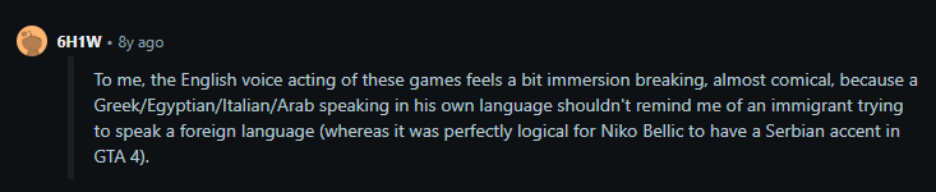
- Representation through voice: Audio that sounds rooted in a region helps players feel seen. A well-cast local voice-over (VO) can make a game feel like it was made with their particular experience in mind.

Praise often follows performances that embrace slang, pacing, or humor familiar to local audiences. On the other hand, backlash is quick when characters feel “translated” instead of interpreted. As we’ve said before, it doesn’t take long for players to sense when a voice truly belongs in their world and when it doesn’t.
Consistency Across Regions
On the player side, Isabel also notes a shift in recent years toward an increased expectation for consistent audio quality across all supported languages. “For a long time, full voice-over and higher production budgets were concentrated in core markets within North America, Western Europe, Japan, and parts of LATAM, particularly Brazil,” she says. “These regions typically received full dubbing, professional casting, and dedicated direction.”
By contrast, many EMEA subregions, including Eastern Europe, the Middle East, and parts of Africa, as well as much of Southeast Asia within APAC, often had to rely on subtitles or partial VO, limited to UI elements, or major cutscenes. “That gap is now far more visible to players,” Isabel says.
One reason for that visibility are social platforms filled with side-by-side comparisons. YouTube and TikTok channels highlight differences in voice performance, direction, or coverage. The Last of Us Part II, for instance, has dozens of fan-made videos comparing Arabic, Brazilian Portuguese, and English VO, sparking detailed commentary across Reddit and Twitter.
“This is a great way for players to express their expectations, on a big stage, on a large scale, for consistency and quality across all languages, and not just the ‘primary’ markets,” Isabel says. “As a result, we are seeing a rise in demand for AAA-level dubbing quality in languages that historically received less investment. More regions now expect full dubbing, not just subtitles or partial VO.”
Player demand does not mean every project can realistically support full VO in every language, but it does mean that decisions concerning scope, quality, and communication carry more weight than they used to, and that players are paying close attention to how those decisions play out.
The Takeaway
Community sentiment cannot be reduced to mere background noise, since it is a live signal that shapes how localized audio is cast and delivered across the world. As expectations rise, so does the need for early studio investment in culturally relevant voice acting across more markets.
It’s no longer enough for developers to localize for the top five languages and hope for the best. Every player expects to feel included in the story, and voice is often the first and most lasting impression they’ll have from a game. In the end, studios that go the extra mile tend to see their efforts reflected in the loyalty that players feel toward a game, which keeps them coming back.